Key Takeaways:
-
A chest X-ray provides two-dimensional images of the lungs, heart, chest bones and blood vessels and is often used as the first test when lung cancer is suspected.
-
Abnormal findings may include a lung nodule under 3 cm, a larger mass over 3 cm, a neoplasm or other lung lesions, which appear as lighter areas against the darker air-filled lungs.
-
Dense tissues such as tumours, fluid or scar tissue absorb more radiation and appear as shades of grey or white, while bones show up brightly and normal lung tissue appears black.
-
A chest X-ray cannot confirm if a suspicious area is benign or cancerous and is mainly used as a screening tool to decide if further investigation is needed.
-
It is quick and non-invasive, usually takes around 15 minutes, and is often the first step in detecting lung cancer, though more detailed scans or biopsies are needed for diagnosis.
What is lung cancer?
Lung cancer is a serious condition where abnormal cells start growing in the lungs. These abnormal cells are called cancerous cells, and over time, they can multiply to form a tumour that can affect how your lungs work.
More than 43,000 people are diagnosed with lung cancer in the UK every year, which makes it one of the most common cancers. It tends to affect older people and is rare in people under 40. Smoking is the most common cause of lung cancer, although it’s possible to have never smoked and still develop the disease.
The symptoms of lung cancer include a persistent cough, coughing up blood, ongoing breathlessness, unexplained tiredness or weight loss, or pain when breathing or coughing. If you notice symptoms like these, it’s important to speak to a doctor so they can arrange checks, reassure you, or move things forward quickly. However, many people don’t experience any symptoms in the early stages of lung cancer.
What types of lung cancer are there?
If cancer starts in the lungs, it’s called primary lung cancer. Cancer that spreads to the lungs from other parts of the body is called secondary lung cancer.
There are two main types of primary lung cancer.
The most common type is non-small cell lung cancer (NSCLC), and it makes up around 80% - 85% of all cases of lung cancer. NSCLC can be one of three types:
- squamous cell carcinoma
-
adenocarcinoma
-
large cell carcinoma
The other type of lung cancer is small-cell lung cancer (SCLC). It’s less common and tends to spread more quickly.
What is a lung cancer x-ray?
An X-ray is a painless, non-invasive imaging test that uses low-dose radiation to generate two-dimensional, detailed images of the body’s internal organs, particularly dense structures such as bones. A lung cancer chest x-ray visualises the lungs, heart, bones of the chest (i.e., rib cage and spinal bones), and blood vessels, revealing any signs of cancer or other lung diseases.
A doctor may order a lung cancer x-ray to evaluate your lung health if you have smoked for a long time or if you are experiencing symptoms such as wheezing, breathlessness, clubbing (widening) of the nails, chest pain, persistent cough or coughing up blood.
How does an X-ray detect lung cancer?
Your doctor will often recommend a chest X-ray as the first step. An X-ray creates an image of your chest, showing the lungs, heart, and surrounding structures.
On an X-ray image, a lung tumour may appear as a pale grey or white mass. However, an X-ray can’t confirm cancer on its own, as sometimes non-cancerous conditions can look similar, such as infections or collections of pus in the lung.
That said, an X-ray is an important first step in diagnosing lung cancer. If your doctor suspects cancer, they'll refer you for more detailed scans and tests to reach a definitive diagnosis.
How is a chest x-ray for lung cancer done?
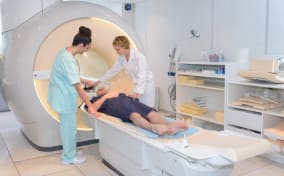
Depending on the specific view(s) needed, a radiographer (trained X-ray technician) will direct you to sit, stand, or lie down. For standing or sitting images, you will point your shoulder outwards, join your hands and raise them slightly above your head.
If lying down on your back, your arms may be placed by your sides or raised above your head. In any case, you will be positioned in front of an X-ray machine. If an extra side-angle image is needed, you will be asked to turn to your side and raise your arms above your head.
During the scan, the machine will send a beam of radiation through your chest to an X-ray detector on the opposite side, which captures an image reflecting the densities of different tissues.
Dense tissues absorb a significant amount of radiation and appear solid white or shades of grey, while less dense materials that allow radiation to pass through appear black on X-ray images. Therefore, the bones of your chest will appear white, air in the lungs will appear black, and fluids and soft tissues (e.g., blood vessels, fat, and muscles) will appear in shades of grey.
How long does a chest x-ray for lung cancer take?
The entire process is quick, typically taking around 15 minutes, during which the radiographer may instruct you to take a deep breath and hold it for a few seconds to ensure the images are clear and detailed.
What does a chest x-ray show for lung cancer?
To suggest the presence of lung cancer, abnormal chest x-ray images might show an area or growth that differs in density compared to surrounding healthy tissues.
But, the details provided by the imaging are usually not sufficient to allow the level of characterization—including analysis of its shape, margin, vascular network (i.e., how it gets blood supply), and cellular activity—that'll determine whether the growth is benign (non-cancerous) or malignant (cancerous).
On a lung cancer chest x-ray report, an abnormality suspected to be cancerous may be described using any of the following terms:
-
Lung nodule: A small, round or oval-shaped spot on the lung that's under 3 centimetres (approximately 1.2 inches) in diameter.
-
Lung mass: A growth greater than 3 centimetres in diameter.
-
Lung neoplasm: Any new, abnormal growth, be it a lung nodule or mass.
-
Lung lesion: Any type of abnormal tissue in the lung, which can include inflammatory changes, infections, or tumours.
-
Shadow on the lung: An area of increased darkness on the lung, indicating a tumour or simple overlap of normal chest structures.
What does lung cancer look like on X-ray images?
We mentioned how images formed by an X-ray reflect the densities of the different tissues inside the chest. Well, on X-ray images, normal lungs appear dark due to the air filling them, which lets radiation pass through.
On the other hand, abnormalities such as fluid, scarring, and tumours (which may or may not be cancerous) are dense and absorb a significant amount of radiation, so they stand out as a light grey or white-coloured mass against the dark background of the air-filled lungs.
Early lung cancer X-ray images may show a small, solitary white shadow or spot (nodule). While this shadow could also be due to non-cancerous conditions like cysts or infections, its detection is a crucial first step in diagnosis.
In contrast, stage 4 lung cancer xray images may show a more pronounced, hard-to-miss bright mass, as well as multiple irregularities or complications such as spread to different regions within the chest, pleural effusion (fluid buildup around the lungs), blood clots or infections like pneumonia.
Chest x-ray: normal vs abnormal lung cancer results
We asked our Chief Medical Officer, Dr Khalid Latief, who is a consultant radiologist with over 25 years of experience, about the differences between a normal chest x-ray and one that is abnormal and shows lung cancer. He summarised :
‘A normal CXR (chest x-ray) shows lungs as dark because they contain air and no solid tissue. When lung cancer is present you see a ‘shadow’ which is white in appearance on the background of black lungs.‘
While not all shadows on lung x-rays will be cancer, having a shadow in your x-ray images could be a sign that you need further tests or investigations as lung cancer could be present.
How accurate is chest x-ray for lung cancer?
A chest x-ray is highly effective for spotting abnormalities, so it is often the first port of call when lung cancer is suspected. However, it can’t definitively distinguish between cancer and benign masses such as lung abscesses. Therefore, it is used as a preliminary test to determine whether more detailed tests are necessary for further investigation.
Sometimes, very early lung cancer x-ray images may not reveal any abnormalities at all, creating a false sense of calm—or psychological distress when symptoms persist—and potentially delaying necessary intervention.
This missed detection often occurs because early-stage cancer can be smaller than 1.5cm, hide behind bony structures (e.g., the collarbone) or manifest as a small mass or nodule inside the blood vessel and cystic airspaces, which may be missed by X-rays but detected through more sensitive diagnostic tests.
Other times, lung cancer may be masked by conditions with similar appearances, such as bronchitis or pneumonia. These commonly occurring situations further emphasise the importance of additional testing.
What’s the link between pneumonia and early lung cancer x-ray results?
Aside from the fact that lung cancer shares overlapping symptoms with pneumonia, a chest infection which causes inflammation in the lungs, they also appear the same way on X-ray images.
Pneumonia often shows up as a white or light grey spot against the black background of the air-filled lungs, similar to early or first-stage lung cancer. Therefore, if pneumonia is diagnosed but does not respond to treatment, further investigation with more advanced imaging tests might be necessary to rule out cancer.
What other tests are there for lung cancer?
A lung cancer xray is only a helpful starting point for what should be a comprehensive diagnostic process. Other detailed tests for lung cancer include:
-
Computed tomography (CT) scan. It is the gold-standard test for diagnosing and staging lung cancer in symptomatic patients and comes highly recommended as an annual screening tool for people at higher risk of the disease.
-
Ultrasound.
-
Magnetic resonance imaging (MRI).
-
Biopsy.
If you are unsure about which scan will be most valuable for identifying the cause of your symptoms and providing information you can trust, consider booking a consultation for £50.
You'll match with an expert clinician who will call to discuss your medical history and unique health experience, educate you on the use cases, benefits and risks of the available test options, and offer a no-obligation referral to the scan that's right for your specific needs.
What will my treatment and outcome look like?
It’s completely natural to wonder what comes next. How your cancer develops and how it’s treated can depend on a few things, such as the type of lung cancer you have, how early it’s been found, and your overall health. An early diagnosis often means more treatment options are available.
Your treatment plan might include surgery, radiotherapy, chemotherapy, targeted therapy, or immunotherapy, and sometimes a combination of these. But your medical team will explain what each option involves, and you’ll be supported at every step, with space to ask questions and make decisions that feel right for you.
Why is an X-ray still a good option?
Chest X-rays are quick, accessible, and often the first sign that something needs further investigation. While an X-ray can’t confirm lung cancer alone, it plays an important role in early diagnosis and referral to a specialist.
Where can I find support if I’m worried about cancer?
A possible cancer diagnosis can feel overwhelming. You don’t have to manage it alone. Your GP, hospital team, and charities such as Macmillan and Cancer Research UK can offer emotional support, practical advice, and reliable information.
How can I arrange an X-ray for lung cancer?
If you’re using the NHS, it’s not unusual to wait a few weeks for a GP appointment and referral, followed by another wait for your results. That can feel like a long time when you’re already worried.
With Scan.com, you can complete your own referral form online in just a few minutes. It’s reviewed by a qualified clinician, such as a private GP or radiologist, who will call you to discuss your details and ensure the scan is right for you.
After your scan, a specialist radiologist carefully reviews your X-rays and prepares a report. Your results are then shared with Scan.com’s clinical team, who will contact you to explain what they show and what might happen next. In most cases, you’ll hear back within seven to ten working days of your scan.
If you're concerned about your lung health, don't wait. Booking a chest X ray today will set you on the fastest track to finding out what’s happening inside your chest and receiving effective treatment. Scan.com is the UK’s largest imaging network. With us, you can browse over 150+ scanning centres nationwide, compare prices, and book the earliest time at a location near you, all in a matter of minutes. No GP referral needed. No long waiting lists. No hidden costs.
Sources:
-
Bell, J. (2018, June 29). Lung cancer associated with cystic airspaces | Radiology Reference Article. Radiopaedia. Retrieved April 29, 2024, from https://radiopaedia.org/articles/lung-cancer-associated-with-cystic-airspaces
-
Chest X-Ray. (n.d.). Johns Hopkins Medicine. Retrieved April 29, 2024, from https://www.hopkinsmedicine.org/health/treatment-tests-and-therapies/chest-xray
-
Chest X-ray sensitivity and lung cancer outcomes: a retrospective observational study. (2021, July 27). NCBI. Retrieved April 29, 2024, from https://www.ncbi.nlm.nih.gov/pmc/articles/PMC8321437/
-
Lung cancer - Diagnosis. (n.d.). NHS. Retrieved April 29, 2024, from https://www.nhs.uk/conditions/lung-cancer/diagnosis/
-
Lung Cancer Early Detection | Lung Cancer Screening. (2024, January 29). American Cancer Society. Retrieved April 29, 2024, from https://www.cancer.org/cancer/types/lung-cancer/detection-diagnosis-staging/detection.html
-
Medical X-rays. (n.d.). National Institute of Biomedical Imaging and Bioengineering |. Retrieved April 29, 2024, from https://www.nibib.nih.gov/science-education/science-topics/x-rays
-
Missed lung cancer: when, where, and why? (n.d.). PubMed. Retrieved April 29, 2024, from https://pubmed.ncbi.nlm.nih.gov/28206951/
-
Pneumonia | Lung inflammation - Diagnosis, Evaluation and Treatment. (n.d.). Radiologyinfo.org. Retrieved April 29, 2024, from https://www.radiologyinfo.org/en/info/pneumonia
-
Tests for lung cancer. (n.d.). Cancer Research UK. Retrieved April 29, 2024, from https://www.cancerresearchuk.org/about-cancer/lung-cancer/getting-diagnosed/tests-for-lung-cancer